A Website That Sells vs. a Website That Sits
Pretty is not the point. What a designer-only rebuild skips (search, reviews, a clear next step) and what a business-first makeover does instead.

Three years ago, you paid good money for a new website. It looks better. It still doesn't sell. Visitors arrive, look around, and leave without calling, booking, or filling in anything. The phone stays quiet.
If that sounds familiar, the problem usually isn't your designer's taste. It's everything the redesign left untouched. In Stanford's web credibility research, three in four people said they judge a company's credibility by its website design.1 Most of your customers look you up before they ever make contact, so your website is doing more selling than your sales team, or it isn't.
Pretty isn't the same as profitable
Design matters. It buys you the first glance, the moment a visitor decides whether you're a real business or a gamble. A dated site actively costs you: it tells your best prospects you've stopped investing.
But credibility is not conversion. A beautiful site with no next step is a brochure with better lighting. It earns the glance and loses the customer.
Conversion is a chain of small decisions: where am I, what do they offer, can I trust them, what do I do next. Design answers the first. The other three (clarity, proof, and the next step) are writing, structure and placement problems, and a designer-only rebuild rarely touches them.
What a designer-only rebuild misses
Let's talk about what a rebuild costs. WebFX, which draws on what more than 2,000 businesses report spending on their sites, puts freelance design at $500 to $10,000 and up, and agency design at $3,000 to $30,000 and up.5 Across more than 400 projects on DesignRush, agency builds and redesigns for small businesses landed between $5,000 and $20,000.6
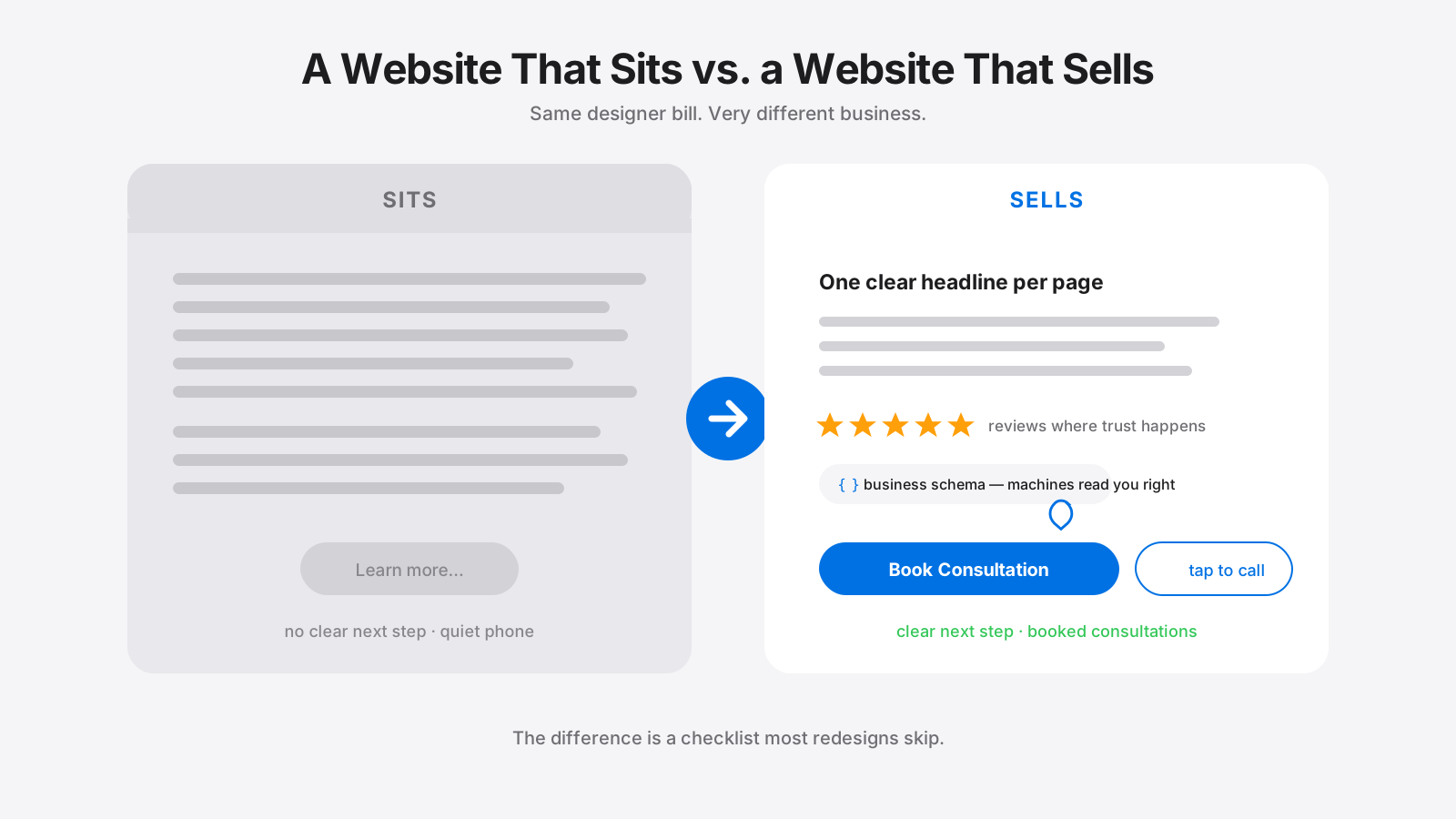
Look at what that invoice covers: discovery, custom design, development. Now look for what's missing. Who should the site convince? What should search engines find on it? What happens in the ninety days after launch? You paid for a new look; the business problem was never scoped. Side by side:
| A site that sits | A site that sells |
|---|---|
| Looks polished, but has no clear purpose | Looks great and is built to turn visitors into calls |
| Dense copy and vague messaging | Clear messaging about what the customer gets |
| Services, prices and contact details are hard to find | Services, prices and contact details on the first screens |
| Not built for search or AI tools | Plain facts on the page that search and AI tools can read |
| No clear next step, or a hard one | One obvious way to book, call or ask, on every screen |
So the new site goes live, looks modern, and behaves exactly like the old one. Six months later the phone is still quiet, and "we need a new website" starts sounding like a broken record. The site wasn't the problem. The scope was.
Your second audience isn't human
More searches now end on the results page itself: for news searches, the share that ended without a click rose from 56% to 69% in one year.2 In a 2025 Pew Research Center study, about one in five Google searches showed an AI summary at the top.3
Picture it: a customer asks an AI assistant for a good salon nearby. Your website gets read, summarized, cited, or skipped. How that goes depends on work a designer was never asked to do: your services, hours, prices and service area stated plainly on the page, matching your Google Business Profile, plus structured data so search engines can read those facts without guessing.
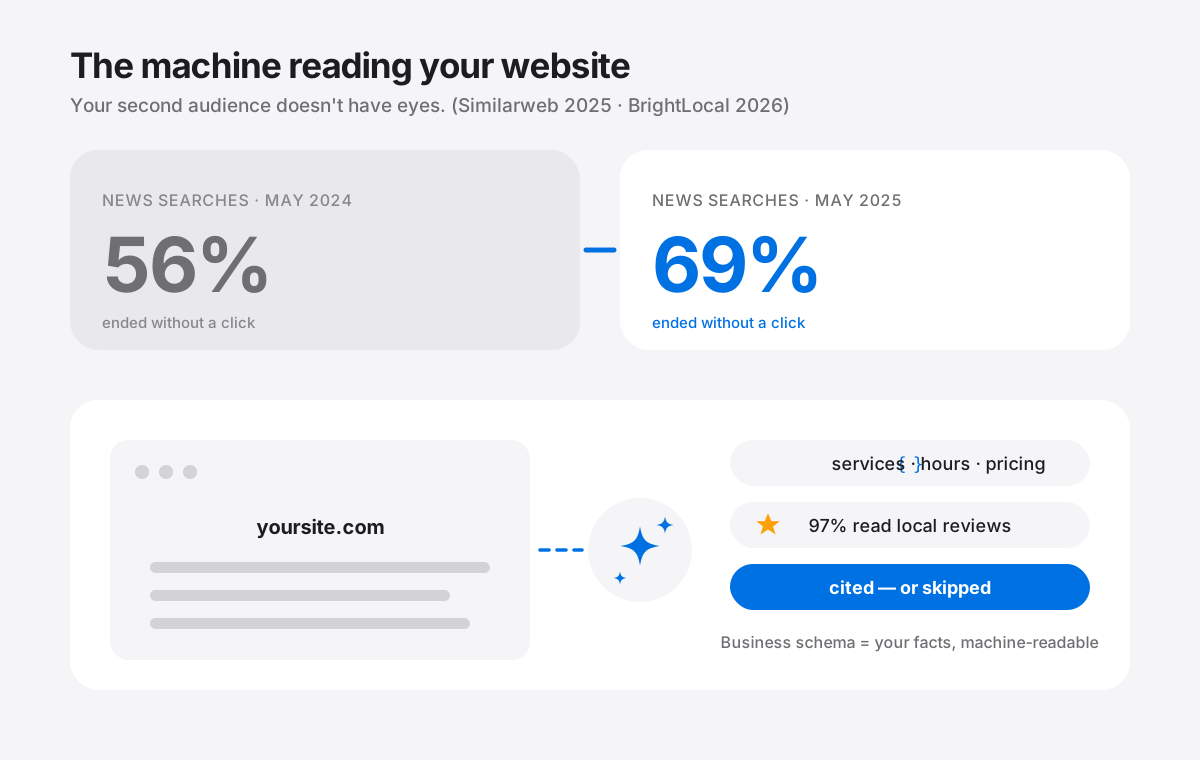
Reviews ride along in that same layer. 97% of consumers read reviews of local businesses,4 and AI assistants increasingly quote them. Star ratings placed where trust decisions happen are the evidence both audiences are looking for.
Writing for machines and writing for skeptical humans used to be two jobs. On a small business website in 2026, they are one.
The six essentials of a website that sells
Every CompeteFocus rebuild starts from your free snapshot (what your market searches for, what competitors do, where the openings are). The scope covers six things a designer-only rebuild leaves out:
- 01Search optimizationPages built around the words your customers actually search.
- 02AI search readinessPlain facts, a complete Business Profile, and structured data.
- 03Customer reviewsStar ratings placed where the trust decision happens.
- 04Clear calls to actionOne obvious next step on every screen: book, call or ask.
- 05Transparent pricingPrices or starting prices, so visitors can budget instead of guess.
- 06Social proofYour real work, photos and client stories where buyers look.
Each part has a job. Search decides whether the right strangers find you. AI readiness decides what machines say about you when you're not in the room. Reviews and social proof close the trust gap. The call to action tells visitors what to do next, and clear pricing removes the last excuse to hesitate: visitors who can't find a price assume it's too high.
And the parts compound. Search brings the visitor. Proof earns the trust. The call to action and pricing turn trust into a booking. Remove any one and the funnel leaks.
Case in point: Arc Beauty Lab
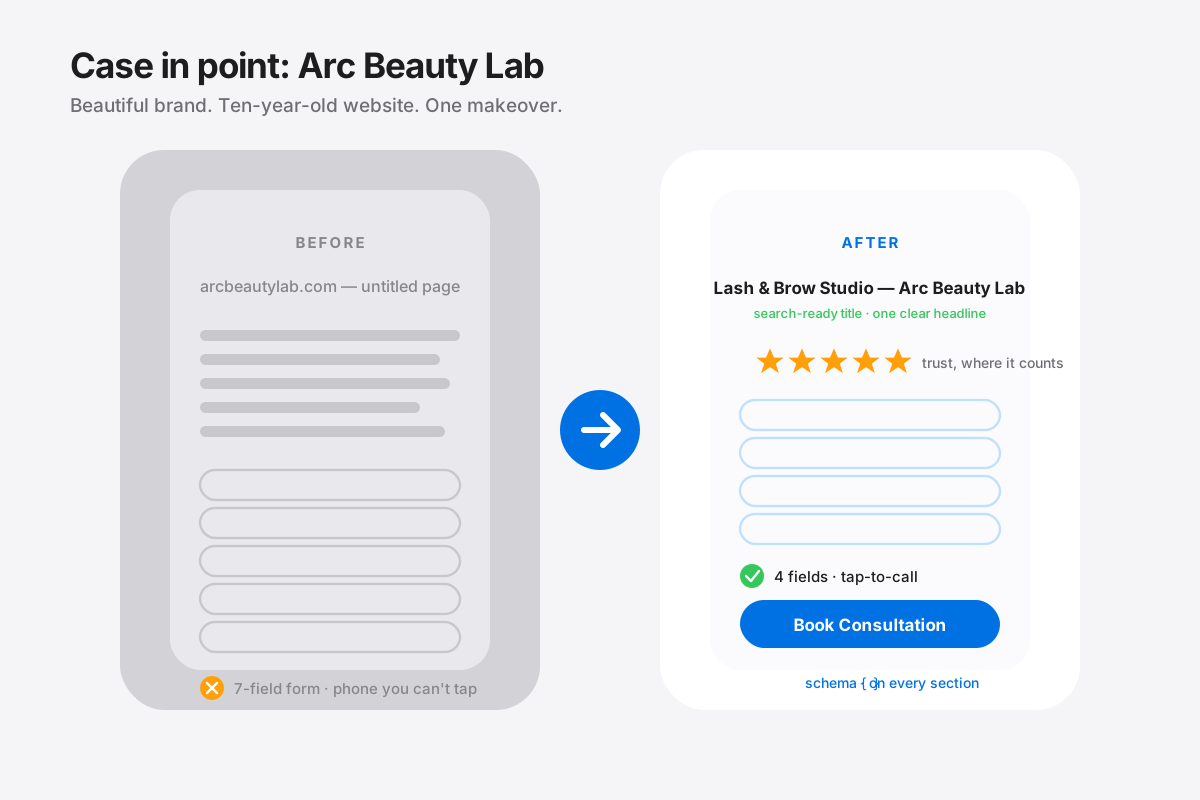
A beautiful brand with a ten-year-old website.
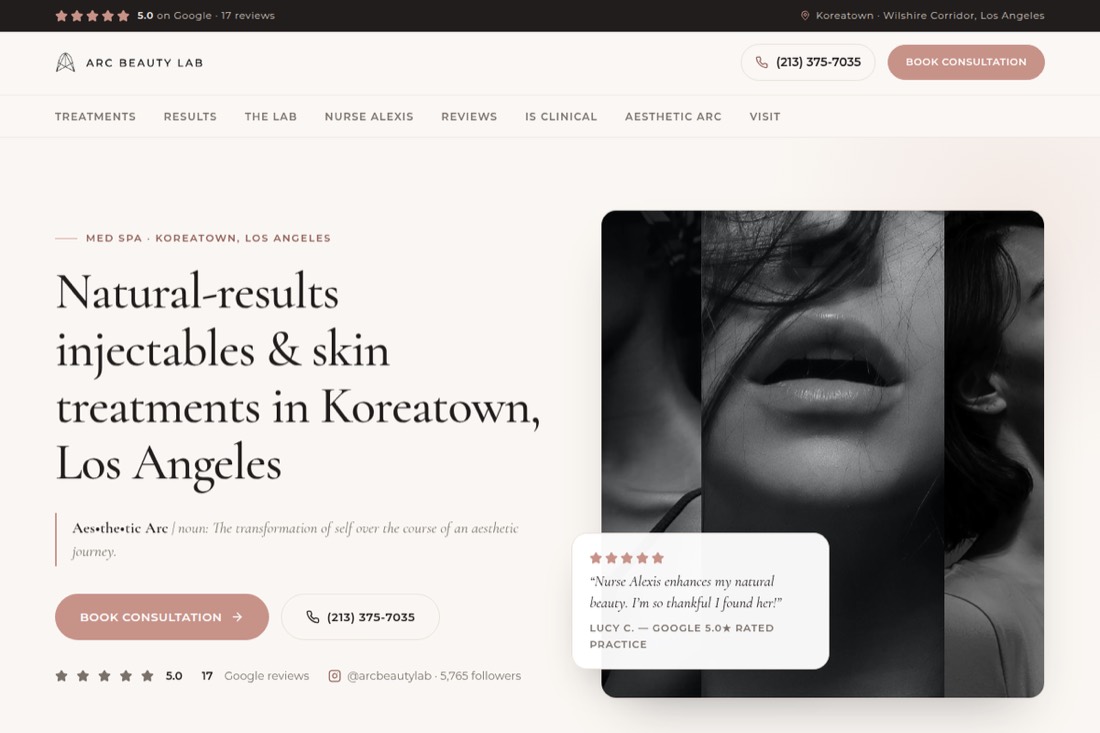
A wall of text, no clear next step, a fourteen-character page title, a seven-field form, and a phone number you couldn't tap on a phone.
Search-ready page titles, one clear headline, tap-to-call, Book Consultation on every section, the 5.0 Google rating up front, and a four-field form.
Nothing here is exotic. It's a checklist, done completely. Read the full Arc Beauty Lab before and after →
Launch is not the finish line
A rebuilt site that launches into silence wastes its own head start. Search engines take weeks to re-index a new site. Reviews build momentum when they're asked for consistently. Social channels need something new to point at. None of that happens by itself on launch day.
That's why we plan the roll-out before the site goes live: which pages publish in which order, when review requests go to your happiest customers, which social posts point back to the new site, and when we check what's working.
See where you stand. Then let's fix it.
Your free snapshot compares your website and reviews with your 5 top local competitors, and gives you a short plan.
Get my free snapshotFree · Delivered in 2 business days · No credit card
We rebuild websites and take on the marketing jobs small business owners keep putting off. Every post here comes from our own client work. What we do →
Sources
- Stanford Persuasive Technology Lab, Stanford Web Credibility Research (Fogg et al.).
- Similarweb, The Impact of Generative AI: Publishers (2025): share of news-related Google searches ending without a click, May 2024 vs May 2025. Coverage: TechCrunch.
- Pew Research Center, Google users are less likely to click on links when an AI summary appears, July 2025.
- BrightLocal, Local Consumer Review Survey 2026 (published Feb 11, 2026): 97% of consumers read reviews for local businesses.
- WebFX, How Much Does a Website Cost?: freelancer design $500 to $10,000+, agency design $3,000 to $30,000+, based on spending shared by 2,000+ businesses.
- DesignRush, Web Design Budget Guide for Businesses in 2026 (updated Dec 8, 2025): small-business custom sites and redesigns $5K to $20K, based on 400+ verified DesignRush projects.