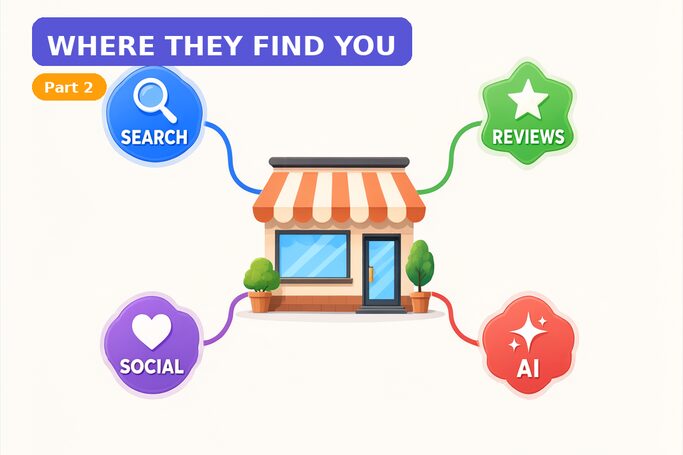
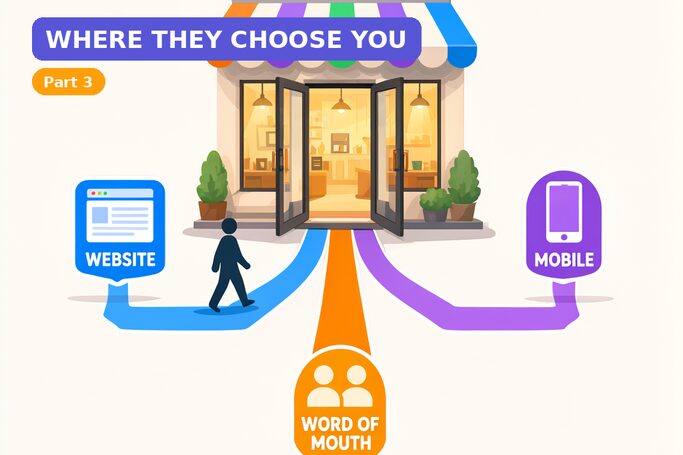
The Seven Front Doors Customers Use to Find Your Small Business
Search, reviews, social, mobile, AI: customers now reach a small business through seven doors. Part 1 walks each one and what it takes to keep them open.

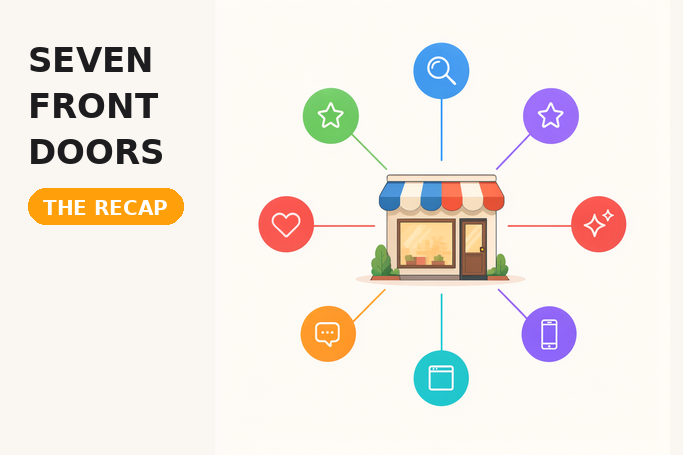
Your next customer is choosing between seven ways to reach you right now. They might Google you, ask an AI assistant where to go, read your reviews, or scroll past a competitor's feed before deciding. Nearly all of them read reviews before they pick a local business.1 Each of those channels is a door you either keep open or let go stale.
This is Part 1 of a series on those doors: what they are, why keeping all of them open turned into a full-time job, and who can hold them open for you. First, the doors you already know.
The five channels you already know
Search
Search is still the front door of front doors. People look for something nearby all day long, and when your business matches what they type, that door swings open.
Your website
Your website is the room every other door leads to. It answers the questions the search started: who you are, what you charge, whether you're open, how to book. A good one closes the customer. A stale one undoes every door that fed it.
Email is the one channel where the list is yours. No algorithm decides who sees it. It's the slowest door to grow and the hardest one to take away.
Word of mouth
Word of mouth carries the highest trust of any channel. A recommendation from a real person outranks anything you can buy. It's also the one door you can't post to. You can only earn it.
The phone
The phone is where all of this lands. A call is the last step of intent, not an old-fashioned leftover. When it rings, everything else worked.
How the five work as one path
These five work as one path, not five. A neighbor mentions you (word of mouth), the customer searches your name (search), skims your site (website), and calls (phone). You never see the first step; you only see the last one. That's why the doors that look old-fashioned still do so much of the quiet work, and why neglecting the middle of the path starves the end of it.
None of these five retired. But while you were running the business, new doors opened, and customers walked through them before most owners noticed.
The newer doors: reviews, mobile, social, blog and AI
Reviews
Reviews became word of mouth at scale, and they stopped living in one place. 97% of consumers read reviews for local businesses.1 Your Google rating is no longer the whole story, because recommendations and ratings now surface on social platforms and in AI answers too.
Mobile
Mobile stopped being a variant of your website and became the main entrance. Customers aren't "visiting your site." They're standing on the sidewalk reading it on a five-inch screen, deciding whether to walk in.
Social media
Social media crossed a line that used to sound like hype: it is now a place where people meet a local business for the first time. Your feed isn't a billboard next to the road. It's a road.
Your blog
A blog sounds almost quaint next to all that, until you notice it's the only door that compounds. A post that answers a real customer question keeps bringing search traffic, feeds the facts AI tools read, and gives social something to post. It works while you sleep.
AI assistants
And the newest door: AI assistants. BrightLocal's 2026 survey found that use of ChatGPT and other generative AI tools for local recommendations rose from 6% to 45%.1 More and more of your future customers ask a chatbot instead of typing a search, and the chatbot answers from whatever it can find about you.
The seven doors at a glance
| Door | What the customer does, and what keeps it open |
|---|---|
| Search | Looks for a business nearby. Kept open by an accurate, current Google listing. |
| Reviews | Reads what other customers said. Kept open by steady new reviews and replies. |
| Mobile | Reads your site on a phone, standing outside. Kept open by a fast page with tap-to-call. |
| Social | Meets you in a feed. Kept open by posting regularly about real work. |
| Your website | Looks for the price, the hours and how to book. Kept open by one clear next step. |
| Word of mouth | Hears about you from someone they trust. Earned, never posted. |
| AI assistants | Asks a chatbot who to call. Kept open by the same facts stated the same way everywhere. |
Why marketing seven channels is a full-time job
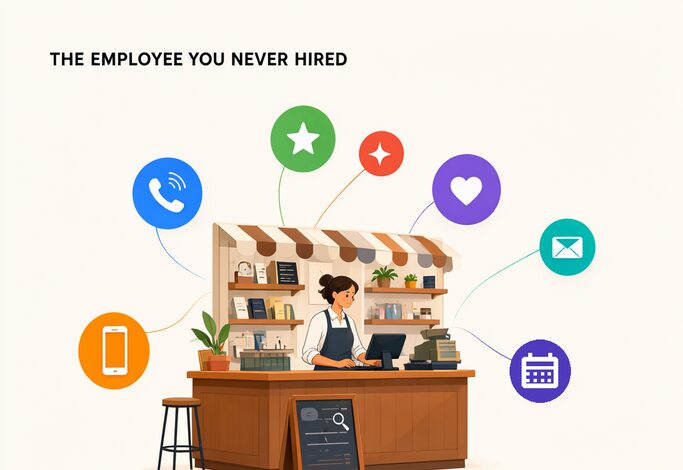
Pick one door and it sounds manageable. Stack all seven and the math turns ugly. Social media alone eats hours every week for most owners, before you answer reviews, keep listings accurate, send the email, update the website and pick up the phone.
At that point you're not describing a chore list anymore. You're describing a job posting. Most owners can't afford that hire, so they make one anyway and pay it in evenings. The marketer you never hired is you.
A marketing hire or an agency retainer works for companies with margins. For a shop with three employees it is out of reach, so the owner keeps the job and the job keeps the evenings.
Why marketing channels go stale
It gets worse. Channels don't just add up; they decay. Wrong hours in your listing. A March review still unanswered in October. An Instagram feed whose last post is from 2022. Each one tells a customer you're not really there.
The rot travels further now, because the AI assistants answering your future customers build their answers from whatever data is current. Stale counts double. There's no finishing marketing, only keeping up with it, which is why "I'll catch up this weekend" never catches up.
Who keeps all seven doors open: CompeteFocus
This is the problem CompeteFocus exists to solve. Not another dashboard to check, but a team that does the work. It starts with a free competitor snapshot that shows which doors matter most for your business, so effort goes where your customers already are instead of everywhere at once.
From there, we take the jobs you keep putting off. Posts and articles arrive finished every month, planned around your real work, for you to approve and share. Your website stays current: hours, services, prices and the structured facts that Google and AI assistants read. For the phone, the door everything else lands on, a virtual front desk can pick up calls and website chats while you're busy and send you who called and what they need. Nothing goes out that you didn't approve.
A month with us looks like this. The first week, your snapshot lands and you pick the two doors that matter most. Finished posts arrive in your inbox, and you approve and share them in a few minutes. When a customer calls while your hands are full, the front desk takes the details so you can call back with context. At month's end, a check-in on what went out and what changed.
The division of labor is simple: the team operates, you approve. You keep the judgment calls and hand over the treadmill. The doors aren't closing. They're multiplying, and the businesses that get found will be the ones with somebody standing at every one of them.
See where you stand. Then let's fix it.
Your free snapshot compares your website and reviews with your local competitors, and gives you a short plan.
Get my free snapshotFree · Delivered in 2 business days · No credit card
We rebuild websites and take on the marketing jobs small business owners keep putting off. Every post here comes from our own client work. What we do →
Sources
- BrightLocal, Local Consumer Review Survey 2026 (published Feb 11, 2026).