Where Strangers Find You: Search, Reviews, Social and AI
Search, reviews, social, AI: the four doors where strangers find a small business, the competitor gap in each, and what staying competitive actually takes.

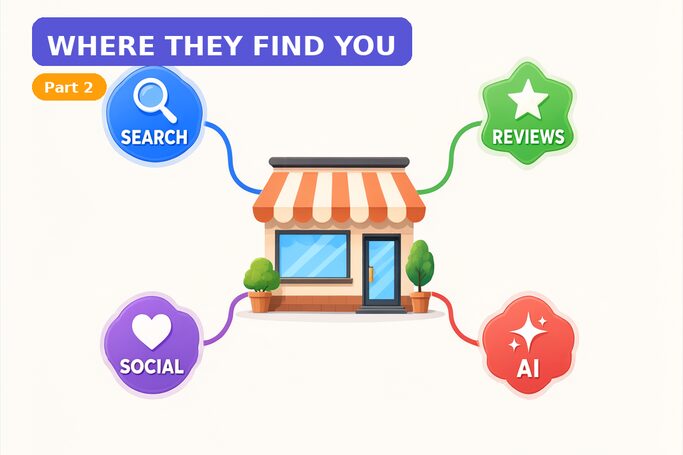
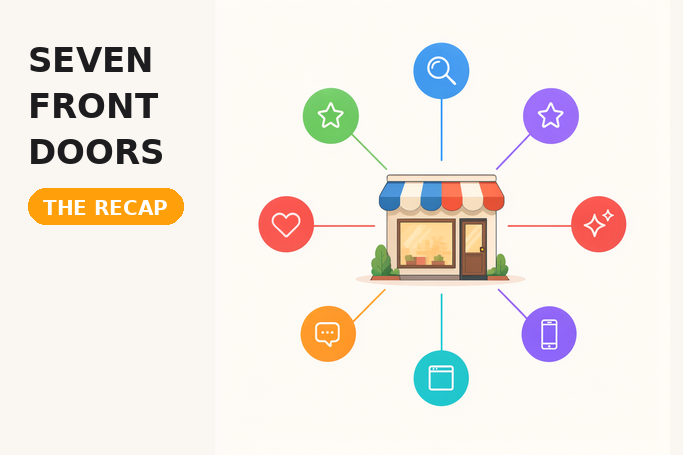
Part 1 of this series walked past seven doors a customer can reach you through. This post opens four of them: search, reviews, social media and AI assistants. These are the doors where strangers find you. The three that decide who chooses you wait for Part 3.
One warning before the tour. At all four doors, the competitor beating you is probably not spending more money than you. They are more current than you. Every point below says the same thing in a different accent: fresh beats finished.
Local search: the rival with the fresher profile
When a local pack loads, Google weighs three things: relevance, distance and prominence.1 Distance you can't change. Relevance and prominence you can. Relevance depends on how well your Google Business Profile matches what someone searches, and Google says complete, detailed business info helps. That starts with the right primary category. Pick the wrong one and you are running the race in someone else's shoes.
Prominence includes your reviews: Google notes that more reviews and positive ratings can help your local ranking.1 So the reviews door you'll read about next also feeds this one. A rival whose profile lists current hours, fresh photos and a trickle of new reviews can beat a better business with a stale listing, week after week.
What staying competitive in local search looks like
It is unglamorous: the right primary category, services written out one by one, hours that are actually true, photos from this year, and something posted to the profile within the last month. None of it costs money. All of it decays.
The local pack is three businesses pinned above everything else, which makes it closer to winner-take-most than a polite ranking. A plumber who posts one update and two job photos to their profile this month is competing for that pin against one whose last edit was during the pandemic. And more searches now end on the results page itself: for news searches, the share that ended without a click rose from 56% to 69% in one year.2 Being the answer on the page matters more each year.
Where CompeteFocus helps: the free competitor snapshot compares your profile with the rivals winning your local pack and lists what yours is missing. On a monthly plan we tune your local search every month, so the decay never gets a head start.
Online reviews: the 20-review toll booth
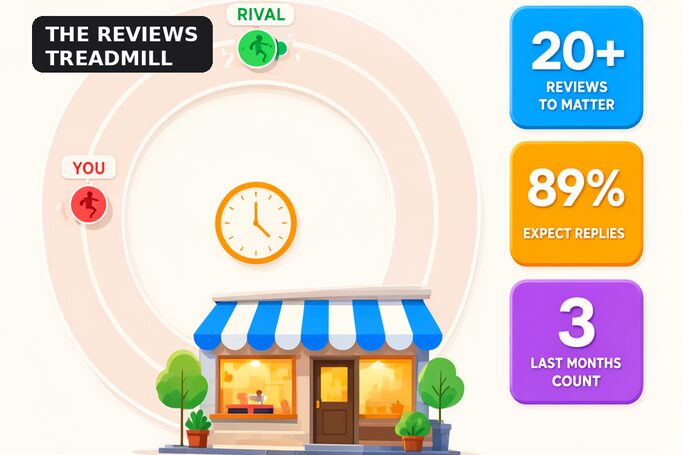
Consumers filter harder than most owners think. In BrightLocal's 2026 survey, 47% would not use a business with fewer than 20 reviews, and only 9% would use one with five or fewer.3 Until you cross that threshold, your rating barely matters. The count is the toll booth; the stars are the road after it.
Replies and recency are the next two gates
Past the booth, two more gates. 89% of consumers expect the owner to respond to reviews, including the mediocre ones. And 74% look for reviews written in the last three months, so a wall of five-star reviews from last winter reads, to this month's customer, like silence.3
How to ask for reviews
The system matters more than the asking. Reviews arrive when you ask at the moment of happiness, the same day, by text, with a link that opens in one tap. Most owners ask sometimes, when they remember, which is how a rival with a routine passes a business with better food.
What to do about a bad review
A calm, short reply written the same week does more for the readers than for the writer. Everyone reading knows customers complain. What they're checking is whether you show up. Your competitor figured out the system: ask every happy customer, answer every review within a couple of days, and let the count and the recency take care of themselves. It is a treadmill, but a slow one. The owners who lose this door are the ones who step off.
Where CompeteFocus helps: the free snapshot shows how your review count and rating stack up against the businesses around you, so you know the size of the gap you're closing. On a monthly plan we also draft replies to new reviews for you to post. The asking stays with you, and the system above keeps that to a few minutes a week.
Social media: consistency beats budget
For a growing number of customers, social is where they first meet a small business. Your feed is not a billboard next to the road, as we said in Part 1. It is the road.
What wins this door is not production value. It is cadence. A phone photo of Tuesday's actual job, posted every week, beats a polished reel every quarter. Customers read a steady feed as a business that is alive. Most owners know this, start strong, and stop by week three. That is the gap your competitor walks through.
Which platform should a small business post on?
Pick one platform, the one your customers actually use, and run it properly. A restaurant lives on Instagram. A commercial electrician lives on LinkedIn. The content is the same either way: the job you did Tuesday, the question a customer asked, the thing you had to explain twice this week. That's a month of posts hiding in every week of work.
Where CompeteFocus helps: a month of posts arrives finished, planned around your real work, the jobs you actually did. You approve them and share them on your own accounts. One platform done weekly beats four done occasionally, and the plan is built on that.
AI assistants: the citation gap
The newest door is the strangest. In BrightLocal's 2026 survey, use of ChatGPT and other generative AI tools for local recommendations rose from 6% to 45%.3 A growing share of your future customers ask a chatbot where to go.
Here is the competitive twist: an AI assistant answers with a short list, not pages of results. When ChatGPT or Perplexity recommends a plumber, it names a handful of businesses, chosen from facts it can verify: your name, your address, your services, your reviews, stated the same way across the places it trusts. If your facts are scattered or thin, the assistant simply doesn't assemble you.
How to get cited by AI assistants
Staying competitive here is quiet work: the same business facts stated identically everywhere, a site a crawler can read, and services and hours marked up so machines can parse them. The businesses getting cited did not buy their way in. They made themselves legible.
Where CompeteFocus helps: we keep your structured facts (hours, services, pricing, locations) current and consistent, so when an assistant assembles an answer, you are assemble-able.
What comes next: the doors where they choose you
Four doors, one currency. Search ranks what's current, reviews trust what's recent, social rewards who shows up, and AI cites what's legible. You don't need a bigger budget for any of them. You need a way to never go stale.
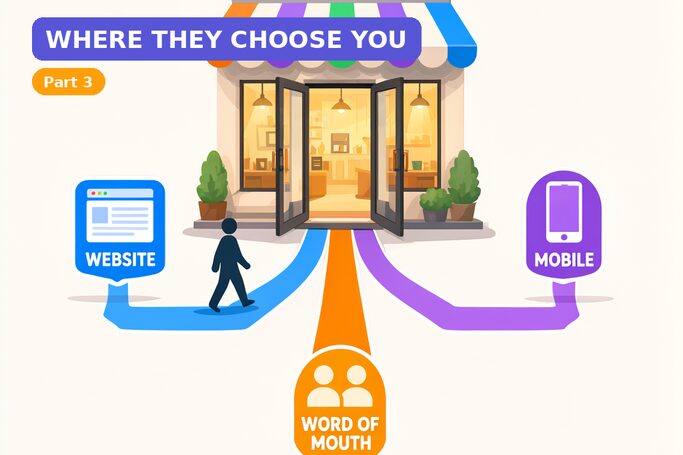
Part 3 walks the other half of the house: your website, the phone in their hand, and word of mouth. Those doors decide who chooses you once they've found you.
See where you stand. Then let's fix it.
Your free snapshot compares your website and reviews with your local competitors, and gives you a short plan.
Get my free snapshotFree · Delivered in 2 business days · No credit card
We rebuild websites and take on the marketing jobs small business owners keep putting off. Every post here comes from our own client work. What we do →
Sources
- Google Business Profile Help, Improve your local ranking on Google.
- Similarweb, The Impact of Generative AI: Publishers (2025): share of news-related Google searches ending without a click, May 2024 vs May 2025. Coverage: TechCrunch, July 2, 2025.
- BrightLocal, Local Consumer Review Survey 2026 (published Feb 11, 2026).