How Customers Choose a Local Business: Website, Mobile and Word of Mouth
Website, mobile, word of mouth, the phone: the doors that decide who chooses your small business, the competitor gap in each, and a three-second self-test.

A regular tells her neighbor about you over the fence. Great teeth, fair prices, no upselling, go see her. That referral is the warmest lead your business will ever get: it arrives trusting you, priced in, ready to book. Then it meets your conversion doors.
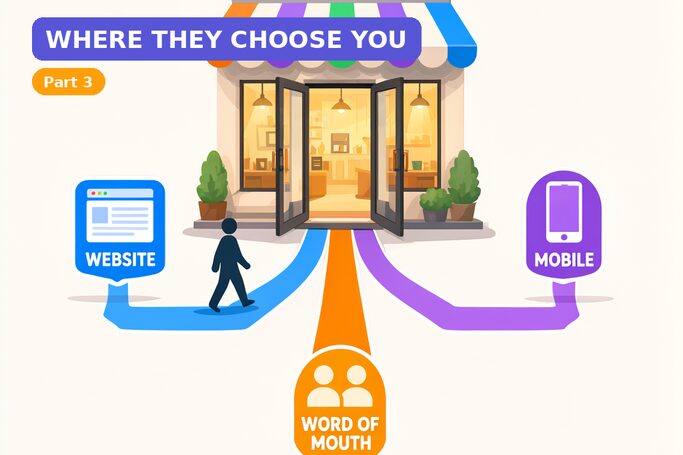
This final part of the series walks the three doors that decide whether people who found you actually choose you: your website, their phone, and the word-of-mouth trail your referral checks before believing. Same rule as Part 2, different currency. The discovery doors ran on recency. These three run on friction: how much resistance stands between a ready customer and the yes they came to give you.
Website: does it ask for the booking?
A surprising number of small business websites ask for nothing. No Book Now button, no phone number to tap, no form. The owner paid for a site, got one that looks like a brochure, and joined a club whose members never ask for the business. Your competitor with an ugly site and a clear Book button is beating you while you wait for yours to feel finished.
Looks still matter, for about three seconds. In Stanford's web credibility research, three in four people said they judge a company's credibility by its website design.1 But the judgment only has to hold while the visitor finds the answer to three questions. What do you do. What does it cost. How do I start. A page that answers those, in that order, converts. A page that makes a ready customer hunt for a phone number does not.
What a website that converts looks like
Structure beats decoration, and it's cheaper. A converting page answers the three questions in order, puts the price where a nervous customer can find it, and asks for one action, not five. The sites that convert best in local business are boring: headline, price, proof, button. If your homepage has a photo carousel and no button, you built the brochure, not the door.
| A brochure site | A site that books |
|---|---|
| A photo carousel and no button | One clear action above the fold |
| Prices behind "call us" | The price, or a starting price, on the page |
| Five actions competing for attention | One action, repeated where the visitor decides |
| A long inquiry form | A form short enough to finish on a phone |
Where CompeteFocus helps: every site we rebuild carries one action above the fold, the pricing a customer expects, and a form short enough to finish on a phone. The free snapshot lists which of those your current site is missing before anything gets redesigned.
Mobile: where tenths of seconds are money
Your customer is not visiting your website. She is standing on a sidewalk, one thumb available, deciding between you and the next listing while her coffee cools.
On that screen, speed is revenue you can measure. In a study Google commissioned from Deloitte, a 0.1 second improvement in mobile site speed was associated with an 8.4% rise in retail conversions.2 A site that takes five seconds on a phone isn't slow, it's closed.
Why small business sites load slowly
What usually makes a small business site slow isn't a mystery, it's weight: a hero video nobody asked for, three fonts, a slider with six uncompressed photos, hosting bought in 2016. None of it is expensive to fix. All of it is easy to ignore, because the owner checks the site on office wifi, where everything loads fine. Your customers don't browse from your office.
Make the phone number tappable
Make the phone number tappable everywhere it appears, and make calling the default action. A customer who has decided wants to talk to a person, not fill out a form. Every extra tap between decision and conversation is a place she can change her mind.
Where CompeteFocus helps: rebuilds are made to load fast, with tap-to-call numbers and one-thumb forms, and on a monthly plan we check speed and how the site works on phones every month. Speed is treated as a door, not a setting.
Word of mouth and the phone it rides in on
Word of mouth still carries the highest trust of any channel. What changed is what happens after the recommendation. The neighbor who heard about you doesn't walk over. She checks your reviews, which 97% of consumers read for local businesses,3 and then she opens your site on her phone. The referral no longer converts on its own. It converts if the digital trail behind it holds up.
The phone: the door nobody tracks
Then the last door, the one nobody tracks: the phone. A ringing phone you can't get to is not a missed conversation. It's a referral, won by word of mouth and lost by an unanswered ring. A caller who reaches no one doesn't leave a voicemail and wait. They call the next listing.
How to make referrals stickier
When a customer says "I'll tell my sister about you," that's the moment to say thanks, here's a card, and would you mind leaving the same words on Google. The referrer becomes your review, the trail confirms the referral, and the next neighbor who checks finds proof instead of silence. One ask, two doors held open.
Where CompeteFocus helps: a virtual front desk can pick up calls and website chats while you're busy, answer the common questions from your hours, services and prices, and send you who called and what they need. It's available as a trial; ask us.
The three-second self-test
You don't need an agency to find these leaks. You need three seconds and a little honesty. Run this at your counter with your own phone. Each step takes about as long as it takes to read it, and your customer grades every one of them daily whether you run it or not.
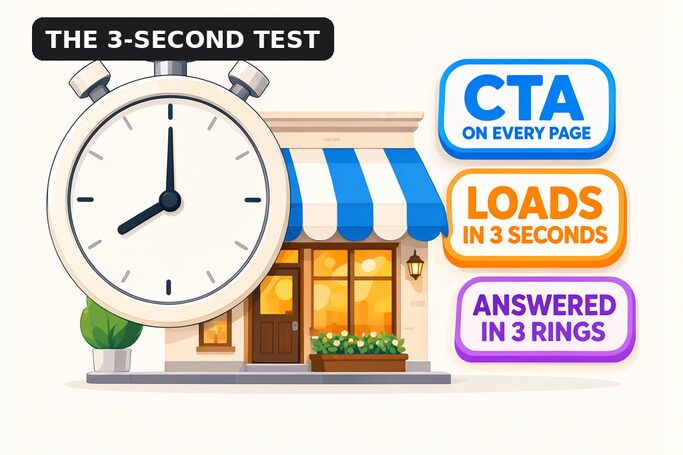
- No button telling a stranger what to do next within three seconds of opening your website: the first fix.
- Homepage still loading at three seconds on your phone over cell data: the second fix.
- Three rings pass when you call your own business from across the counter: the third fix.
And a fourth check, the one that tells you the others are working:
- Read your last five reviews the way a referred customer would. They confirm the referral.
Notice what the three fixes have in common: none of them require more money than the status quo. A button costs nothing. Compression is free. Answering the phone is staffing, or a team. Friction is the rare competitive gap that shrinks whenever someone decides to care about it.
The whole series in one line
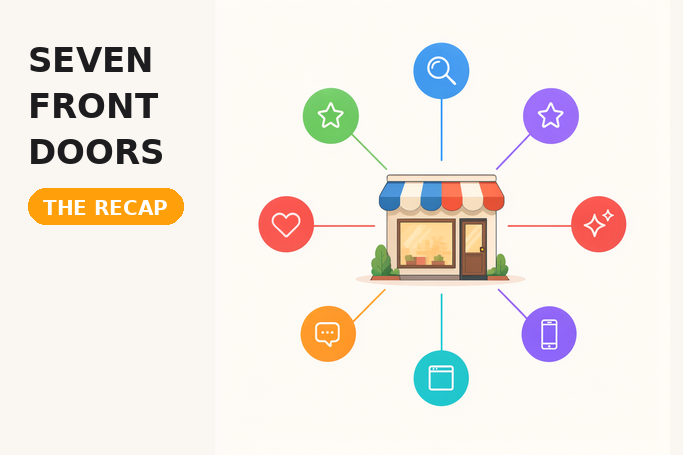
That's the series. Seven doors: four where they find you, three where they choose you. The discovery doors run on recency, the conversion doors on friction, and both run whether you show up or not. A recap with the key points and a one-week action plan closes the series.
See where you stand. Then let's fix it.
Your free snapshot compares your website and reviews with your local competitors, and gives you a short plan.
Get my free snapshotFree · Delivered in 2 business days · No credit card
We rebuild websites and take on the marketing jobs small business owners keep putting off. Every post here comes from our own client work. What we do →
Sources
- Stanford Persuasive Technology Lab, Stanford Web Credibility Research (Fogg et al.).
- Deloitte Digital for Google, Milliseconds Make Millions (2020): a 0.1 second improvement in mobile site speed and an 8.4% rise in retail conversions.
- BrightLocal, Local Consumer Review Survey 2026 (published Feb 11, 2026).